

Peridot doesn’t get talked about the way emeralds and sapphires do, and that’s honestly a shame. This is a stone with a real story behind it: volcanic origins, Egyptian queens, meteorites, the whole thing.
Here’s what makes it worth a second look.
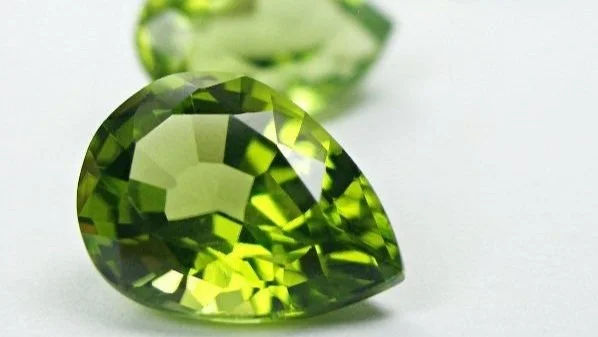
1. It’s the only gemstone that comes in just one colour family
Most gems show up in a range of colours depending on trace impurities. Peridot doesn’t work that way. Its green comes from iron built directly into the mineral structure, not from an impurity, so every peridot lands somewhere on the same yellow-green to olive-green spectrum. No blue peridots, no pink ones. What you see is what the stone is.
2. It’s technically extraterrestrial
Peridot has been found inside pallasite meteorites, chunks of rock and metal that fell to Earth from space. In 2005, NASA’s Stardust probe even brought back comet dust containing traces of it. Along with diamonds, peridot is one of the only gems known to form outside Earth’s crust, deep in the mantle, which is a wild resume for something you can wear on your finger.
3. Cleopatra’s “emeralds” were probably peridots
This one gets repeated a lot because it’s true. Historians now believe much of Cleopatra’s famous emerald collection was actually peridot mined from Egypt’s Red Sea islands. The two stones can look similar at a glance, and peridot has picked up the nickname “Evening Emerald” as a result, even though it isn’t related to emerald at all. Emerald is a beryl. Peridot is olivine.
4. It’s the gem version of a mineral found in Earth’s mantle
Peridot is the gem-quality form of olivine, and it’s brought to the surface through volcanic activity. That’s why so much of the world’s peridot comes from places with a volcanic history, Arizona, Hawaii, the Red Sea islands. The stone is quite literally a piece of what’s underneath us, pushed up by eruptions.
5. Ancient miners worked at night
The Egyptians mined peridot on an island in the Red Sea now known as Zabargad, and legend has it the early miners avoided daylight hours entirely. They believed the stone was invisible in sunlight and could only be found after dark. Whether that’s true or just good storytelling, it says something about how prized this stone already was 3,500 years ago.
6. It sits at 6.5 to 7 on the Mohs scale
That puts peridot in a decent middle ground for durability, harder than glass, softer than sapphire or diamond. It holds up fine in earrings, pendants, and necklaces. Rings need a little more thought since daily knocks and scratches add up faster on a finger than anywhere else.
7. Most of the world’s supply comes from one place in Arizona
The San Carlos Apache Reservation produces a huge share of global peridot, somewhere in the 80 to 95 per cent range depending on the year. Pakistan is known for producing some of the finest, most saturated stones without the brownish tint you sometimes see elsewhere, but in terms of sheer volume, Arizona carries the market.
8. It has a signature inclusion nobody else has
Peridot often contains what gemmologists call “lily pad” inclusions, small disc-shaped formations caused by stress fractures around tiny mineral crystals inside the stone. Most gems try to hide their inclusions. With peridot, this one is basically a fingerprint, and it doesn’t hurt the stone’s clarity or appeal.
9. The name might come from Arabic, or French, or Latin
Nobody agrees on where the word “peridot” actually came from. Some trace it to the Arabic faridat, meaning gemstone. Others point to an old French word tied to the stone’s sometimes oily appearance. There’s even a Latin theory floating around. What we do know is the word has been in use since at least 1245, when an English bishop mentioned it in his will.
10. It’s the anniversary gem for year 16
Beyond being August’s birthstone, peridot is the traditional gift for a 16th wedding anniversary. Given its associations with warmth, renewal, and protection going back to ancient Egypt, it’s a fitting choice for a milestone that’s less about the beginning of a marriage and more about what’s been built since.
Peridot doesn’t need to borrow emerald’s reputation. It’s got its own: a stone formed under real pressure, pulled up from places most gems never touch, and worn by people for thousands of years before anyone had a word for it.
Browse online or pop in to see our peridot jewellery in person.